- Ultrafiltration
Modern Ceramic Ultrafiltration
Modern evidence shows Ultrafiltration is now one of the most effective and essential steps in industrial wastewater recycling
“If you tried UF 10–15 years ago, you
didn’t see modern UF”
“Today’s ceramic systems are the backbone of successful industrial recycling plants”
Legacy Membranes
Unlike early polymer membranes that fouled rapidly with surfactants, our modern ceramic ultrafiltration technology delivers robust, thermal- and chemical-resistant filtration that stands up to demanding industrial conditions.
UF used to be seen as old‑fashioned and ineffective in industrial settings, but that reputation is outdated.
Modern UF systems – especially ceramic UF – are dramatically more effective, more stable, and specifically engineered for industry process wastewater.
The “UF is old tech” idea is a legacy belief based on early polymer UF systems that fouled easily and performed poorly with surfactants.
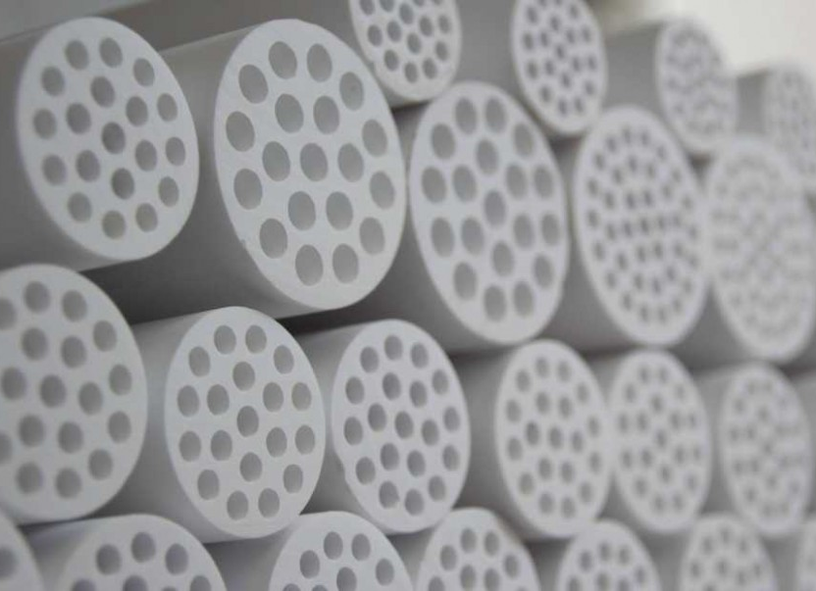
Modern Ceramic Membrane
Durable, chemical-resistant sub-micron ceramic membranes built to withstand rigorous chemical cleanings and deliver an operational lifespan of 15+ years.
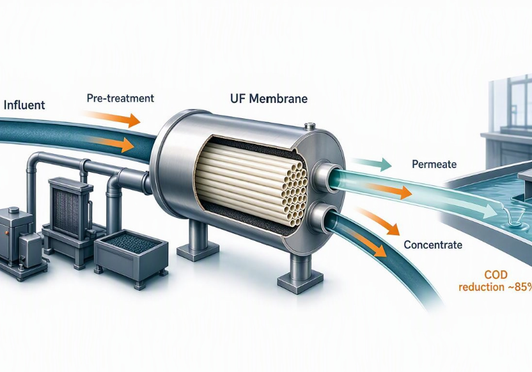
COD & BOD Load Reduction
UF reduces the burden on downstream treatment and cuts effluent surcharge costs, by removing fats, proteins, and solids which are often a large share of a stream's organic load.
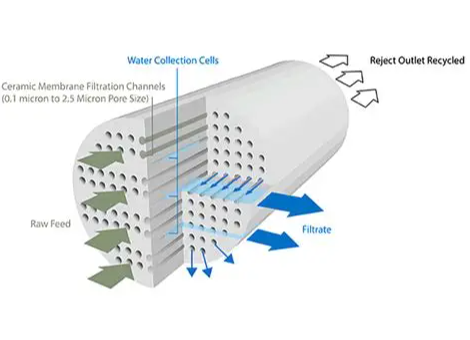
An ABSOLUTE physical barrier
UF rejects suspended solids, fats, proteins, starches, fibres, colloids, and virtually all bacteria and larger pathogens
Proven performance backed by modern research
Modern research demonstrates that ceramic ultrafiltration delivers unmatched resilience and separation efficiency in demanding wastewater environments. Rigorous studies reveal that ceramic UF achieves significantly lower permeability loss compared to microfiltration—sustaining stable fluxes while effectively stripping out microplastics, oils, surfactants, and pathogens. Backed by verifiable empirical data, our sub-micron membrane systems provide the robust foundation required for closed-loop industrial water reuse and significant COD load reductions.
The research supports ceramic ultrafiltration (UF) as a durable option for challenging water and wastewater duties, particularly where abrasive solids, high temperatures, aggressive cleaning chemicals or persistent fouling can shorten the service life of polymeric membranes.
Ceramic UF membranes are typically manufactured from materials such as alumina, titania or zirconia and use fine pores to retain suspended solids, bacteria, emulsified oil droplets and other particulate contaminants. In a comparative study, Hofs et al. found that ceramic membranes offered substantially higher clean-water permeability than the polymeric membranes examined and displayed different fouling and cleaning behaviour, highlighting their potential where robust physical and chemical cleaning is required (Separation and Purification Technology, 2011, 79(3), pp. 365–374, DOI: 10.1016/j.seppur.2011.04.043).
The wider evidence base on membrane bioreactors also shows that membrane filtration can provide reliable solids separation and support high-quality treated effluent for reuse, although performance depends on feed-water characteristics, membrane pore size, operating flux, aeration and cleaning strategy (Le-Clech, Chen and Fane, “Fouling in membrane bioreactors used in wastewater treatment”, Journal of Membrane Science, 2006, 284(1–2), pp. 17–53, DOI: 10.1016/j.memsci.2006.08.019).
Ceramic UF can also be assessed as part of a complete treatment train rather than presented as a universal solution: it can reduce turbidity and particulate COD, protect downstream processes and enable water-reuse schemes, while dissolved salts and many low-molecular-weight dissolved organics generally require additional treatment, such as nanofiltration, reverse osmosis, adsorption or oxidation.

"I had a pre perceived idea about Ultrafiltration and membrane efficacy, but that was due to previous experiences in the late 90's - this new type of modern membrane has really changed my view''
Leading Laundry Operator
Modern research shows that Ultrafiltration (UF) has become one of the highest‑performing, most reliable technologies for wastewater recovery and reuse, thanks to advances in membrane materials, tighter pore structures, nanocomposites, and optimized operating conditions.
UF now consistently delivers high clarity, low turbidity, pathogen removal, and stable, making it a cornerstone of modern recycling systems.
Recent studies demonstrate that ceramic ultrafiltration systems achieve significantly lower permeability loss compared to microfiltration (37% versus 95%) while removing microplastics and surfactants with exceptional consistency.
Modern UF is no longer an experimental alternative – it is the foundation of high-purity water reuse
Overcoming 'legacy' & outdated ultrafiltration misconceptions
In the past, polymer ultrafiltration gained a poor reputation across commercial laundries due to severe fouling from surfactants, rapid flux drops, and complex cleaning requirements. Many operators abandoned these older systems because of unsustainable maintenance cycles.
Today’s ceramic sub-micron systems represent an entirely distinct class of technology. With advanced crossflow designs, high-shear modules, and remarkable resistance to acids, caustics, and oxidisers, our systems maintain predictable flux rates and effortless cleaning cycles even under peak contaminant loads.
Forget the limitations of legacy polymeric membranes. Today’s ceramic ultrafiltration delivers an impenetrable physical barrier, unmatched chemical resilience, and sustained flux rates under the harshest industrial duties. By retaining valuable heat, eliminating trade effluent penalties, and enabling true closed-loop recycling, it transforms wastewater from a recurring liability into your greatest operational asset.
Seamless integration for closed-loop recycling
In the past, polymer ultrafiltration gained a poor reputation across commercial laundries due to severe fouling from surfactants, rapid flux drops, and complex cleaning requirements. Many operators abandoned these older systems because of unsustainable maintenance cycles.
Modern ceramic UF acts as the ultimate barrier, capturing fine suspended solids and emulsified oils so your downstream polishing stages operate efficiently without unexpected shutdowns.
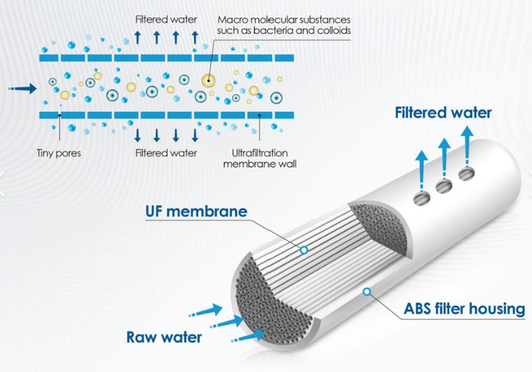
UF membranes have a pore size / molecular weight cut-off (roughly 0.01–0.1 micron, or ~1,000–500,000 Da) that acts as an absolute physical barrier
A clarified, largely sterile permeate — suitable for direct reuse in many non-product-contact applications without further treatment.
A concentrated reject stream — often small enough and valuable enough (protein, fibre) to be worth recovering rather than treating as waste.