- Industry Insights
What's going on with Water
There’s so much to think and talk about in the Industrial water sectors…
- Industry Insights
Ireland's Industrial Laundry Sector
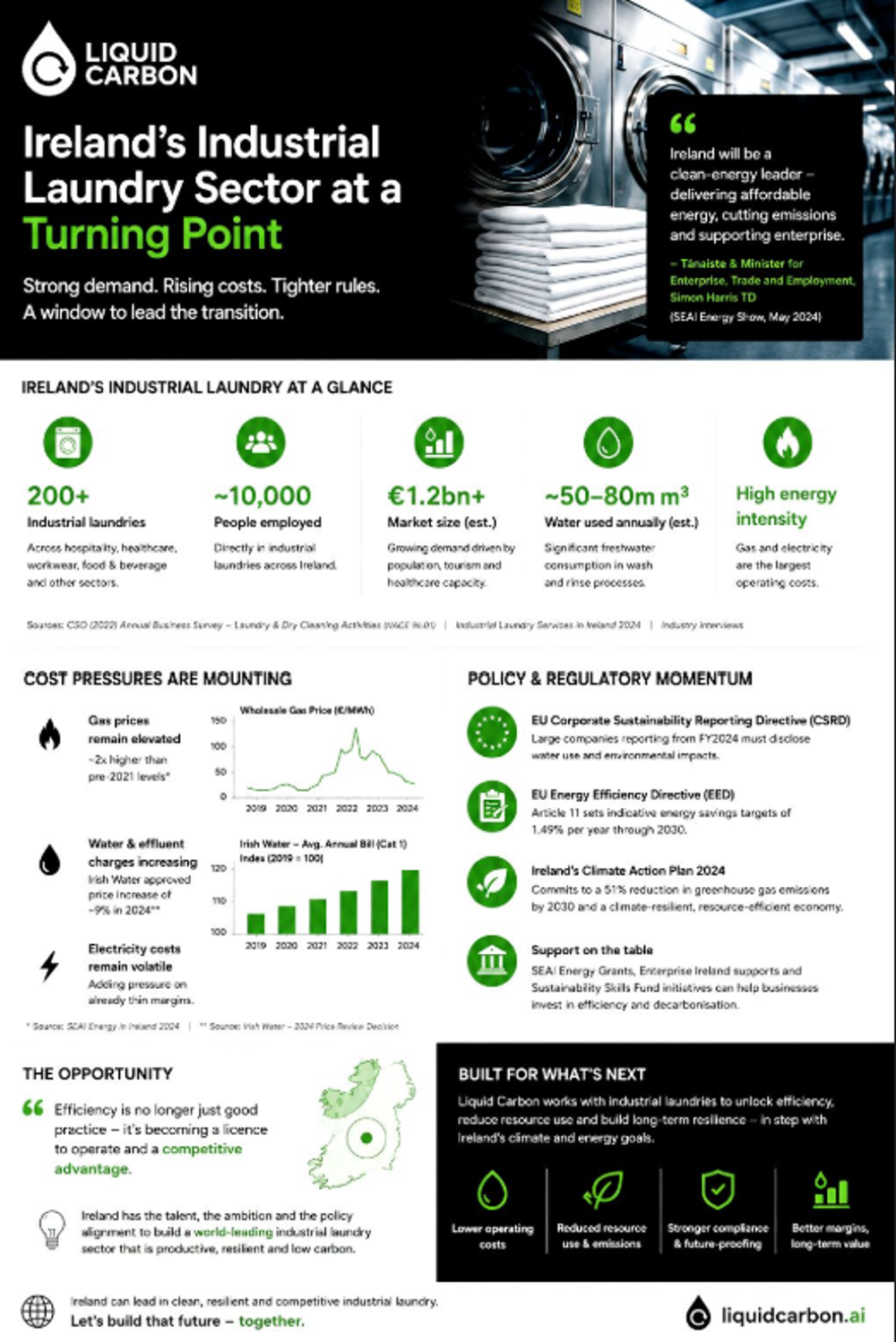
The next margin battle for Ireland’s industrial laundries may be fought at the drain, not at the washing machine. Three numbers explain why:
First, 9.8% – the increase already applied to Ireland’s 2024 non-domestic water and wastewater tariff rates.
Second, 1 October 2026 – the date revised national non-domestic water, wastewater and trade effluent charges are due to take effect.
Third, 51% – Ireland’s legally binding target for reducing national greenhouse gas emissions by 2030.
Industrial laundries sit directly at the intersection of these pressures.
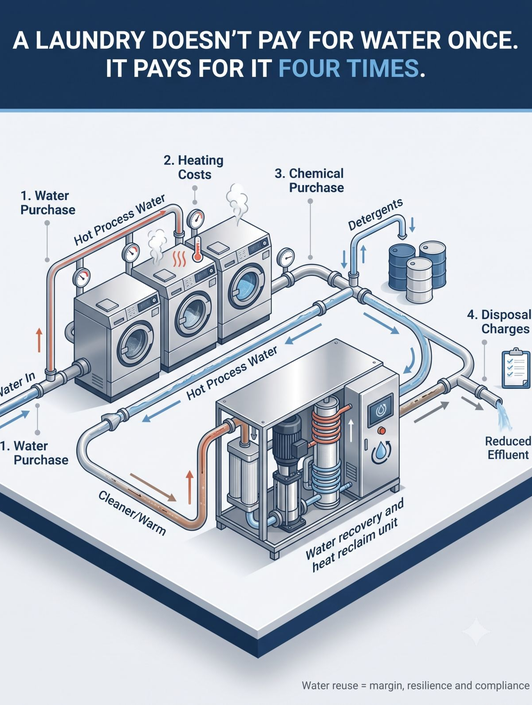
They require large volumes of water. Much of that water must be heated. It is then discharged, often while still carrying usable thermal energy. That creates an unusual cost stack:
1. Water is purchased.
2. Energy is used to heat it.
3. Wastewater is paid for again on discharge.
Ireland’s charging framework treats laundering as a commercial activity under Trade Effluent Category 1. This means most laundries may not face the more complex mogden-based charging structure applied to higher-strength industrial effluent.
But that should not be mistaken for immunity from rising costs.
The commercial incentive remains straightforward: every cubic metre not purchased and discharged, and every unit of heat not replaced, protects operating margin.
Energy prices have eased from the 2022 peak, but Irish business energy remains structurally exposed. Ireland ranked among the EUs higher-cost electricity markets in the second half of 2025, while gas continues to play a material role in industrial heat.
The strategic question for the sector is therefore changing.
It is no longer, “How do we comply with the next environmental requirement?” – It is, rather, “How much water and heat are we paying for, using once, and throwing away?”
- UK Policy
Water Costs in Laundries
UK water policy is starting to point in one direction: Use less mains water. That matters for industry. DEFRA’s latest water demand plan confirms England’s statutory target to reduce public water supply use per head by 20% by 2038.
The 2025 Environmental Improvement Plan goes further for businesses: non-household water use is expected to reduce by 9% by 2038. This is not just a household shower-head story.
The government’s own delivery plan says non-household users account for around 20% of water demand and the top 1% of those users account for half of that.
That should get the attention of Industrial Laundries, Food Processors, Healthcare Laundries, Hotels, Manufacturing Sites and other water-intensive operators. The policy language is also changing.
Water Costs in Laundries
- water reuse options for new non-household development
- water recycling and drainage standards
- tariff structures and incentives for business demand reduction
- stronger data access for water efficiency
- a wider reset of water regulation through the 2026 Water White Paper
Water efficiency is moving from “ESG initiative” to operating requirement. For high-use sites, the question is whether the site can keep paying for avoidable mains water, heat loss and effluent discharge while policy, regulation and customer expectations all move the other way.
Industrial water users should be auditing four things now:
1. Litres in
2. Heat lost
3. Effluent out
4. Reuse potential
That is where UK water policy is heading.
- Efficiency
UK Water Efficiency
The UK water conversation is shifting.
For years, water efficiency was treated as a sustainability nice-to-have.
That is changing.
Ofwat is now consulting on changes to wholesale charging rules so that water scarcity and efficiency can be reflected more clearly in business water charges.
The proposed changes would apply from April 2027.
At the same time, the UK has launched its largest water-saving campaign, with Ofwat, the Environment Agency, the Met Office, Natural Resources Wales and water companies backing a national push to reduce water use.
For water-intensive businesses, this matters. Industrial laundries, hotels, hospitals, care homes and food processors do not just use water. They heat it, treat it, discharge it and pay for it several times over.
The commercial question is no longer simply: “How much is our water bill?”
It is: “How exposed are we to future water scarcity, wastewater charges, energy volatility and customer sustainability pressure?”
That is the space Liquid Carbon is focused on.
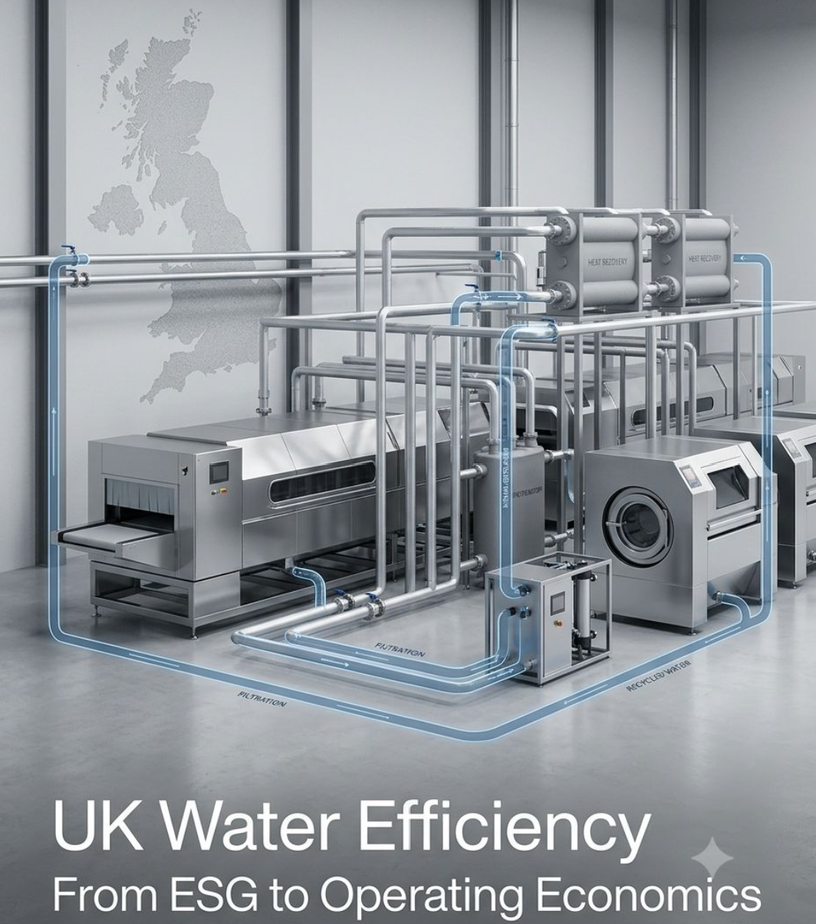
Our work with Quantum One is simple in principle: recover water, reclaim heat, reduce discharge, and improve the operating economics of high-water-use sites.
The policy direction is clear. Water efficiency is moving from the CSR slide into the CFO and operations agenda.
The businesses that move early will not just look greener.
They will be more resilient, more efficient and better prepared for where UK policy is heading.
That is where UK water policy is heading.
- Resource
Wastewater to Resource Efficiency
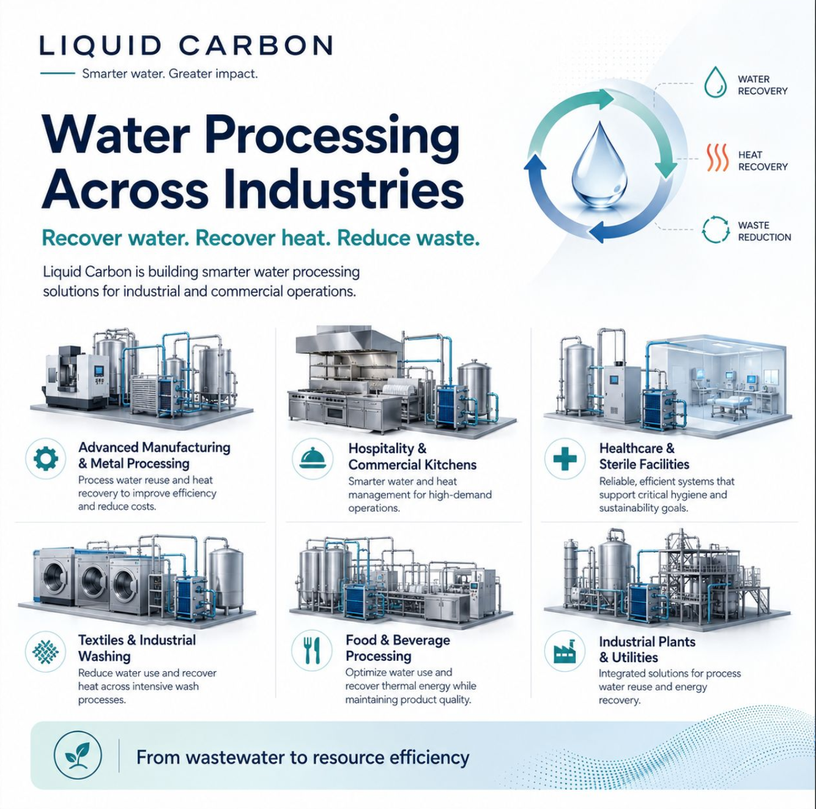
The next efficiency frontier in industry is water processing.
Across industrial and commercial operations, water is often still treated as a linear input:
- Use it.
- Heat it.
- Process with it.
- Discharge it.
But that model carries a hidden cost.
Businesses are not only paying for water. They are also paying for the energy used to heat it, move it, treat it, and then lose it.
At Liquid Carbon, we are working on smarter water processing solutions across industries, helping sites recover water, recover heat, reduce waste, and make better use of existing infrastructure.
For manufacturers, food processors, hospitality operators, healthcare facilities, and other water-intensive businesses, sustainability cannot just be a reporting line.
It has to work commercially.
It has to work operationally.
And it has to survive the test of the plant room.
That is where we see the opportunity.
From wastewater to resource efficiency.